




Brass Figure
Batak, Sumatra, Indonesia
Late 19th–early 20th century
Brass
Provenance: Formerly in the collection of Samuel Eilenberg, NYC
Rodger Dashow collection, Boston
Published: “Indonesian Tribal Art”, Carpenter, Bruce, 2015, pg. 229
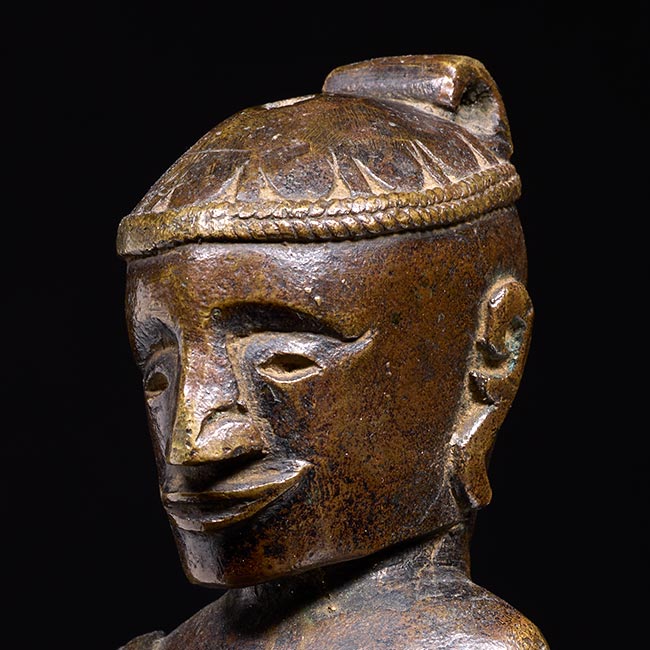
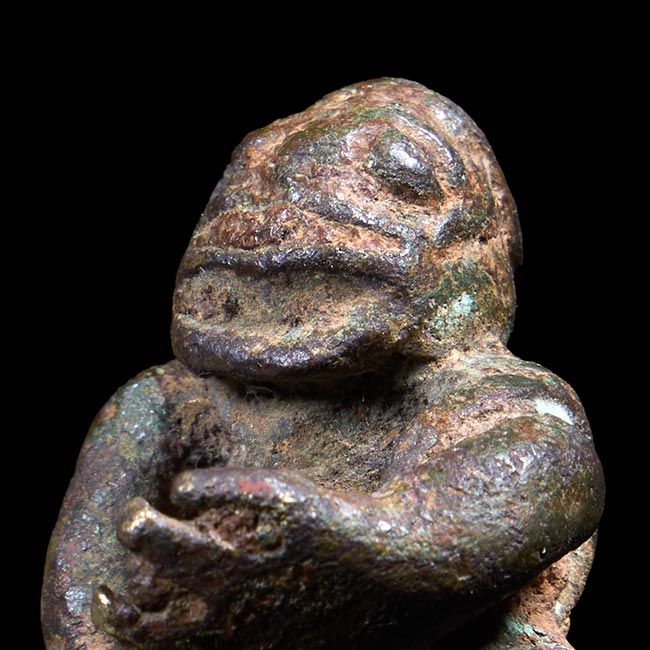
This finely cast brass figure originates from the Batak of North Sumatra and exemplifies the elegant stylization and restrained naturalism characteristic of Batak metalwork. The figure stands upright on a circular base with slightly bent knees, a subtly arched torso, and arms drawn back with raised hands, creating a sense of rhythmic tension and contained movement. The surface bears a deep, warm patina, softened through age and handling.
Although sometimes misidentified as a handle from a ritual implement, this sculpture is not functional in nature. It lacks the structural adaptations and wear patterns associated with tool attachment and is best understood as an independent ritual or symbolic figure, likely cast for use within a domestic or ceremonial context.
The pose suggests motion rather than stillness. Bent knees, forward inclination, and lifted hands evoke a transitional moment—possibly a stylized reference to ritual or ceremonial movement rather than a literal depiction of dance.
___
Alongside his academic career, Samuel Eilenberg assembled one of the most important private collections of Indian and Southeast Asian art, with a particular focus on small-scale sculpture and ritual objects from India, Indonesia, Nepal, Thailand, Cambodia, Sri Lanka, and Central Asia. In 1987, he donated more than 400 works from his collection to the Metropolitan Museum of Art, many of which were later exhibited in The Lotus Transcendent: Indian and Southeast Asian Art from the Samuel Eilenberg Collection (1991–92).
Size
Height: 5 ¾ in / 14.6 cm
Item
IN 2-2-26 / Price on request
Gallery
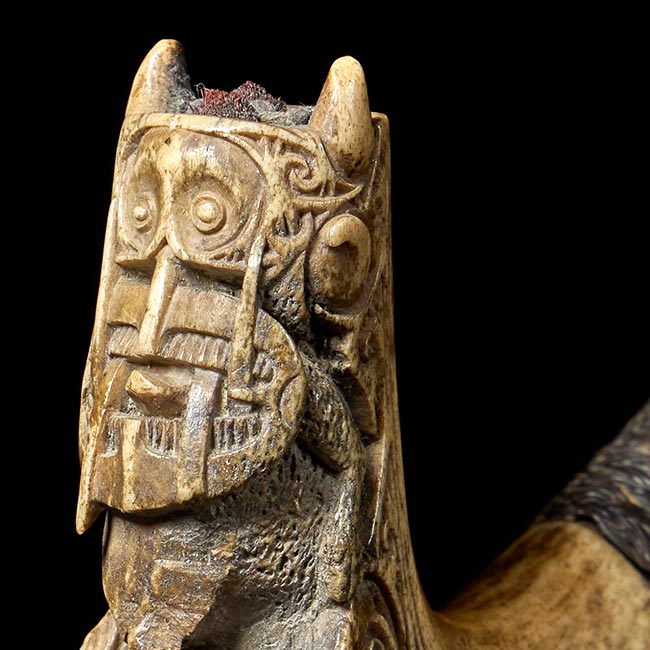

Brass Figure
Batak, Sumatra, Indonesia
Late 19th–early 20th century
Brass
Provenance: Formerly in the collection of Samuel Eilenberg, NYC
Rodger Dashow collection, Boston
Published: “Indonesian Tribal Art”, Carpenter, Bruce, 2015, pg. 229
This finely cast brass figure originates from the Batak of North Sumatra and exemplifies the elegant stylization and restrained naturalism characteristic of Batak metalwork. The figure stands upright on a circular base with slightly bent knees, a subtly arched torso, and arms drawn back with raised hands, creating a sense of rhythmic tension and contained movement. The surface bears a deep, warm patina, softened through age and handling.
Although sometimes misidentified as a handle from a ritual implement, this sculpture is not functional in nature. It lacks the structural adaptations and wear patterns associated with tool attachment and is best understood as an independent ritual or symbolic figure, likely cast for use within a domestic or ceremonial context.
The pose suggests motion rather than stillness. Bent knees, forward inclination, and lifted hands evoke a transitional moment—possibly a stylized reference to ritual or ceremonial movement rather than a literal depiction of dance.
___
Alongside his academic career, Samuel Eilenberg assembled one of the most important private collections of Indian and Southeast Asian art, with a particular focus on small-scale sculpture and ritual objects from India, Indonesia, Nepal, Thailand, Cambodia, Sri Lanka, and Central Asia. In 1987, he donated more than 400 works from his collection to the Metropolitan Museum of Art, many of which were later exhibited in The Lotus Transcendent: Indian and Southeast Asian Art from the Samuel Eilenberg Collection (1991–92).
Size
Height: 5 ¾ in / 14.6 cm
Item
IN 2-2-26 / Price on request
Gallery