



Ceremonial Comb
Timor, Eastern Indonesia
19th century
Provenance: Aldo and Hannie van Eyck collection, The Netherlands
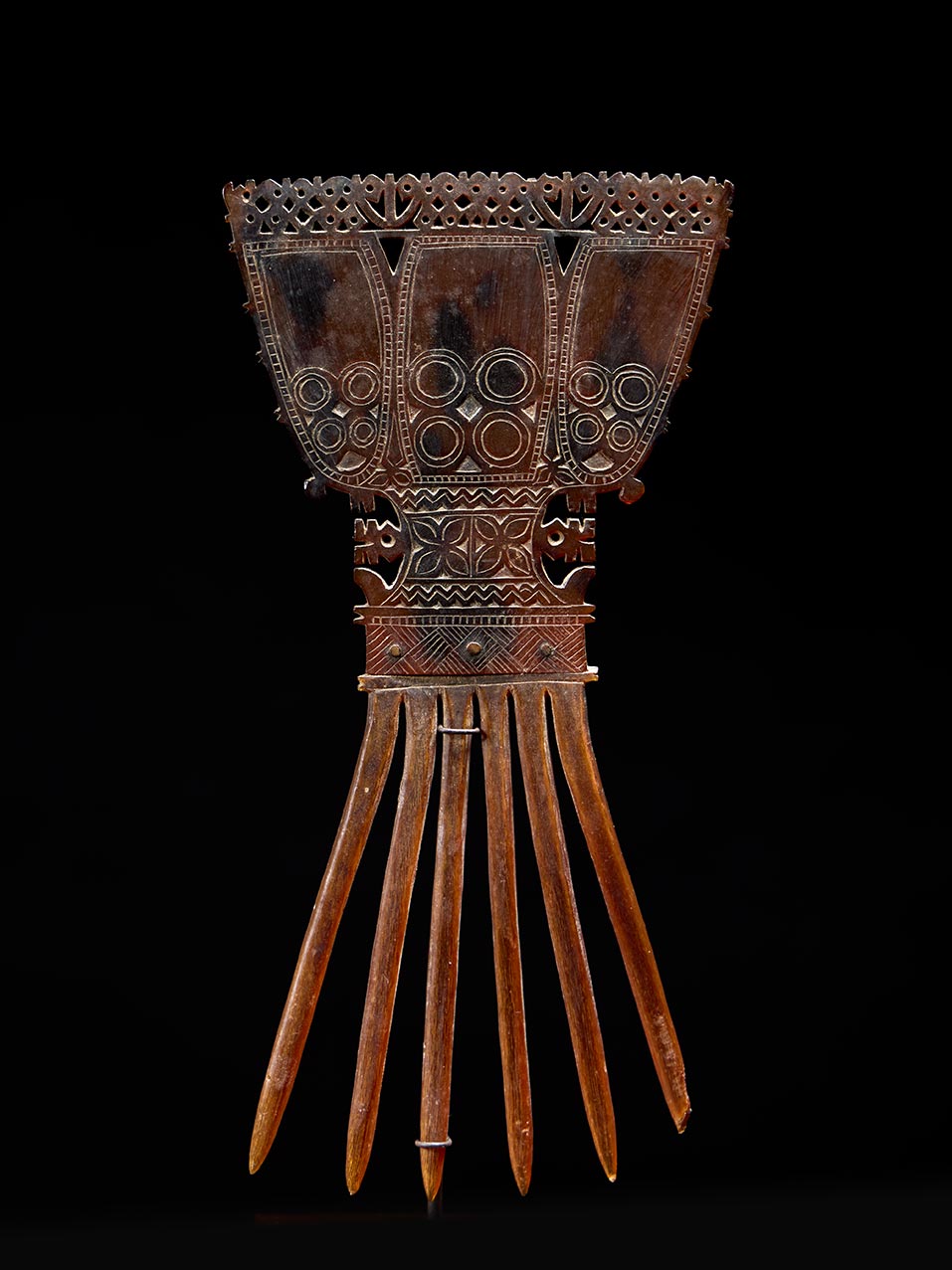
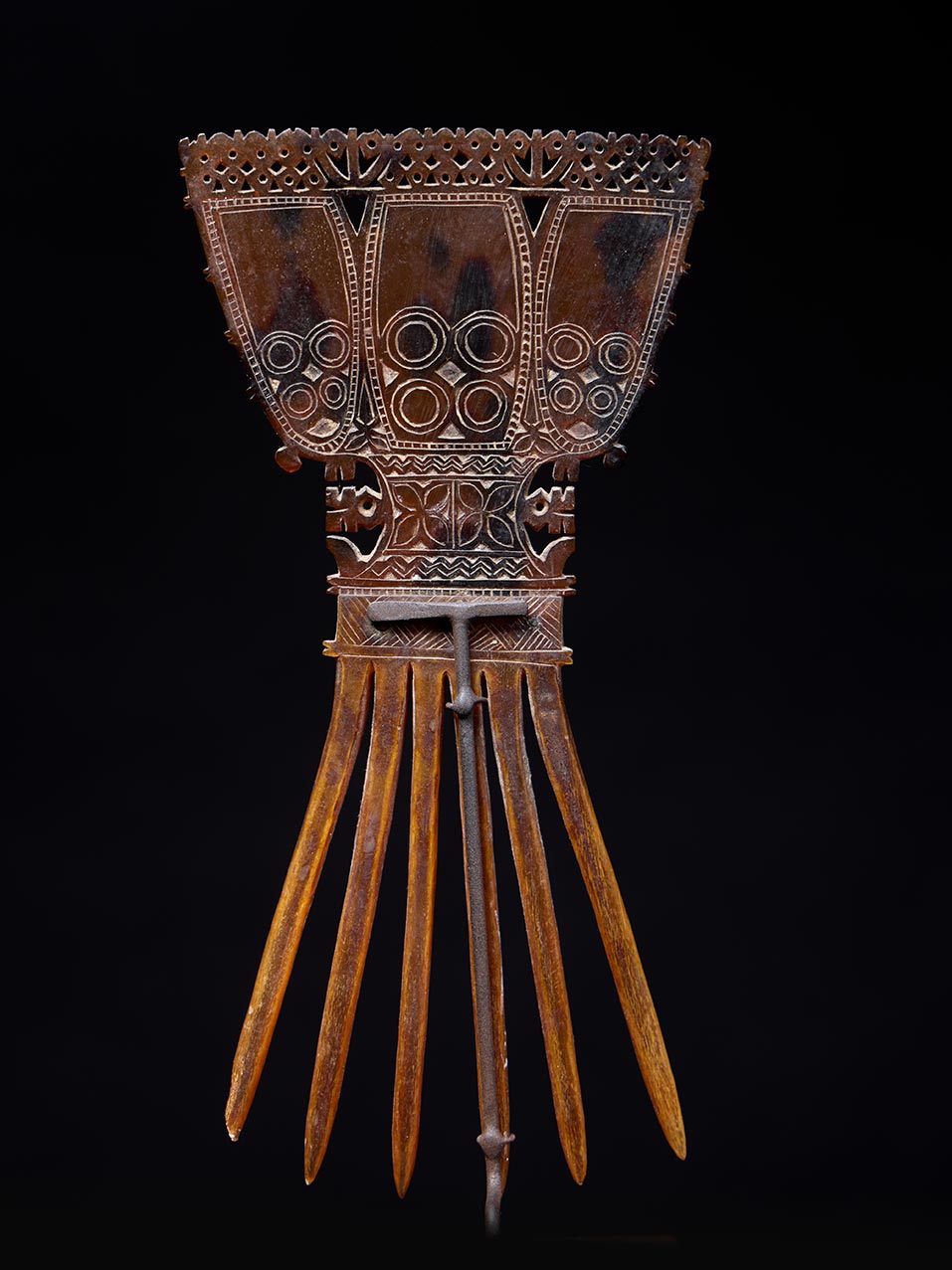
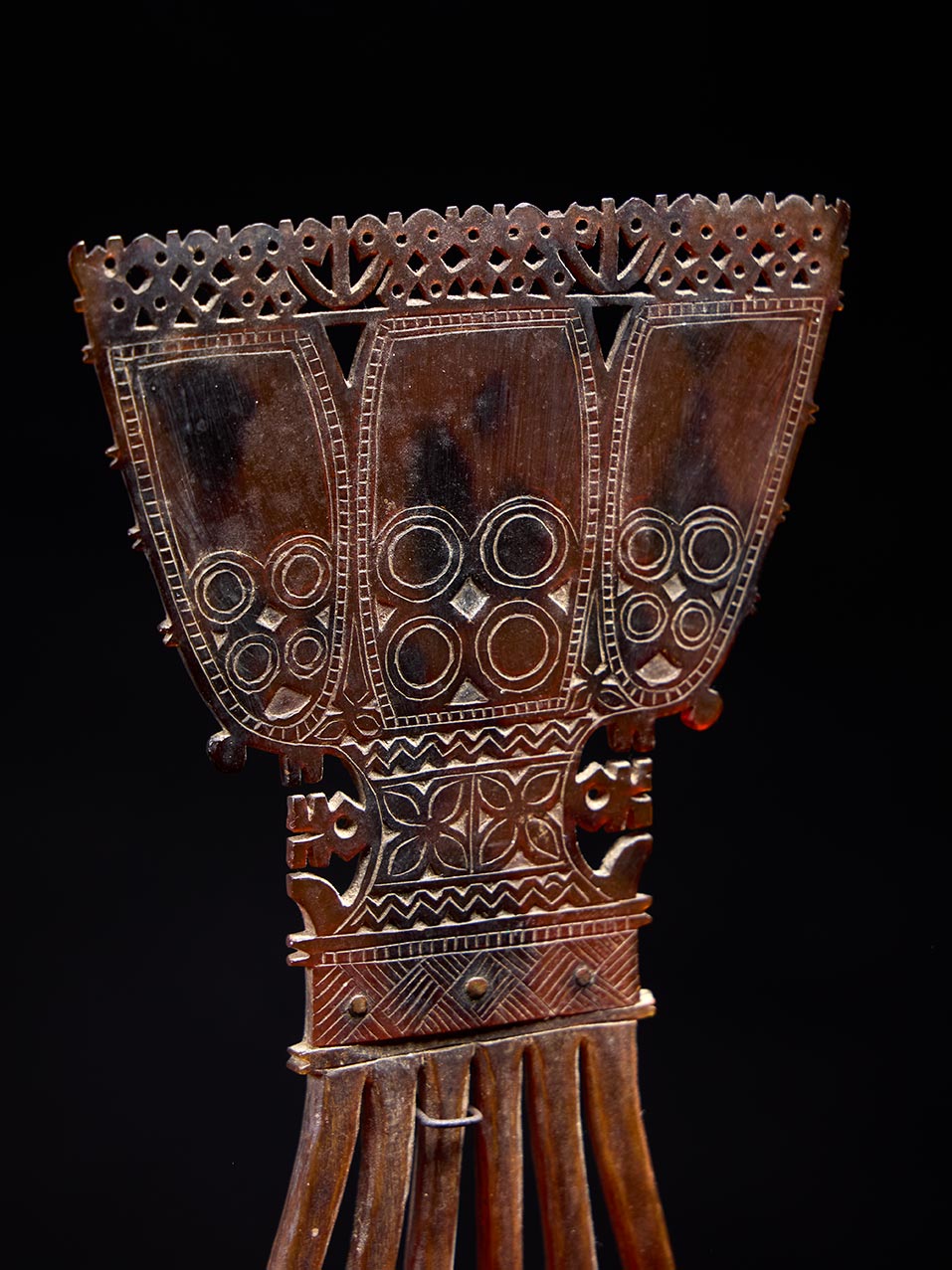
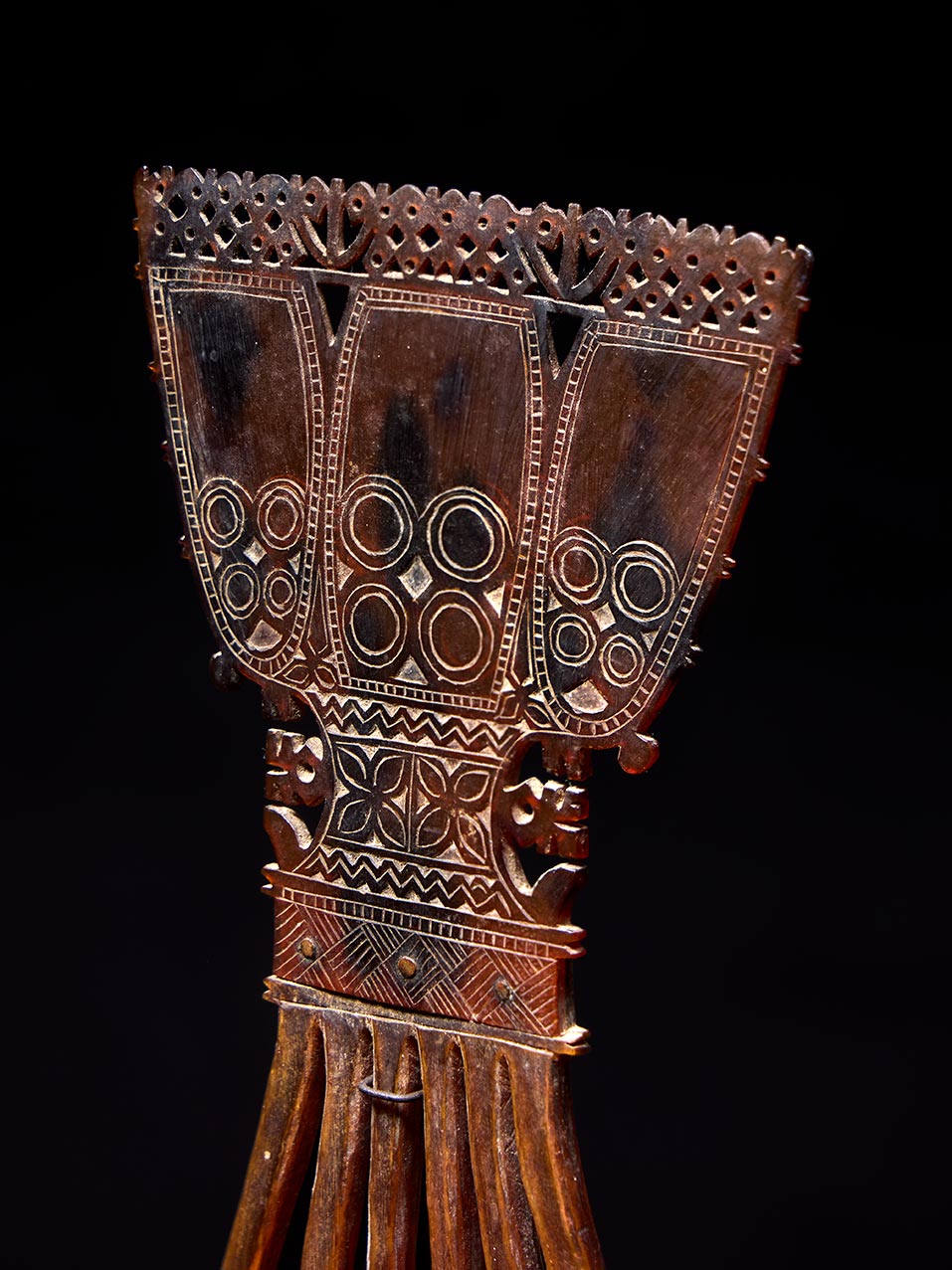
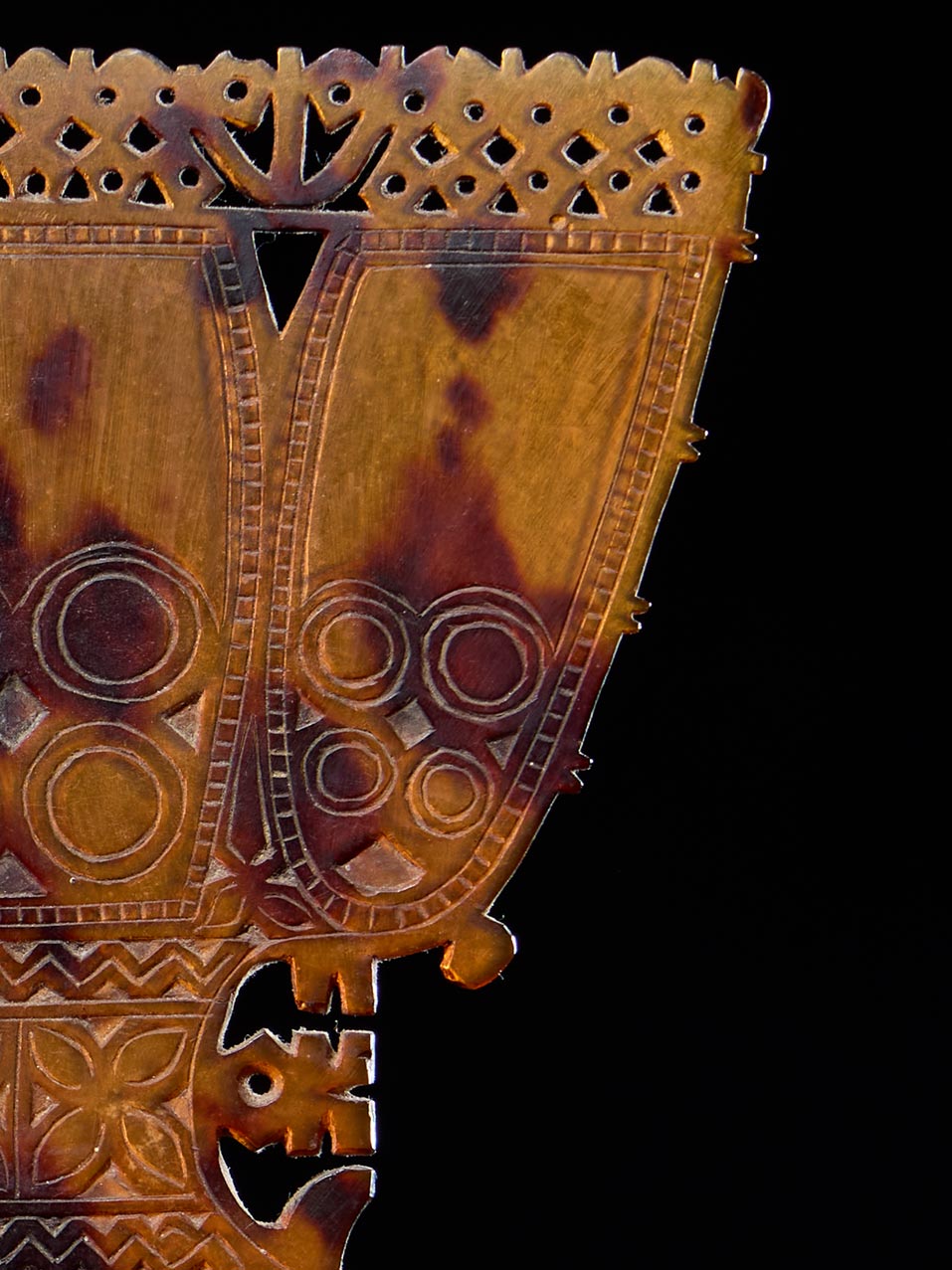
This striking ceremonial comb from Timor is carved from turtle shell, a prized and symbolically charged material throughout eastern Indonesia. When held to the light, the comb reveals a luminous, translucent surface animated by natural mottling—its warm amber tones and dark clouded inclusions lending the object a remarkable sense of depth and vitality. The material’s inherent transparency enhances the delicacy of the carving, giving the comb an almost ethereal presence.
The upper register is elaborately pierced and incised with repeating geometric and vegetal motifs, while the central field is dominated by three elongated, highly stylized faces. These schematic visages—reduced to circular eyes, linear features, and symmetrical framing—are not portraits but ancestral signifiers.
The visual language of these faces bears a compelling resemblance to the stylized mask-like motifs seen on ancient Dong Son bronze drums of mainland Southeast Asia. While separated by geography and time, both traditions share a common Austronesian aesthetic vocabulary: frontal faces reduced to essential forms, circular eyes as potent symbols of awareness and power, and an emphasis on symmetry and rhythmic repetition. Rather than indicating direct copying, this resonance suggests the deep diffusion of symbolic forms across the region, transmitted through migration, trade, and shared cosmological concepts.
Size
Height: 7 in / 17.8 cm
Item
IN 1-4-26 / Price on request
Gallery

Ceremonial Comb
Timor, Eastern Indonesia
19th century
Provenance: Aldo and Hannie van Eyck collection, The Netherlands
This striking ceremonial comb from Timor is carved from turtle shell, a prized and symbolically charged material throughout eastern Indonesia. When held to the light, the comb reveals a luminous, translucent surface animated by natural mottling—its warm amber tones and dark clouded inclusions lending the object a remarkable sense of depth and vitality. The material’s inherent transparency enhances the delicacy of the carving, giving the comb an almost ethereal presence.
The upper register is elaborately pierced and incised with repeating geometric and vegetal motifs, while the central field is dominated by three elongated, highly stylized faces. These schematic visages—reduced to circular eyes, linear features, and symmetrical framing—are not portraits but ancestral signifiers.
The visual language of these faces bears a compelling resemblance to the stylized mask-like motifs seen on ancient Dong Son bronze drums of mainland Southeast Asia. While separated by geography and time, both traditions share a common Austronesian aesthetic vocabulary: frontal faces reduced to essential forms, circular eyes as potent symbols of awareness and power, and an emphasis on symmetry and rhythmic repetition. Rather than indicating direct copying, this resonance suggests the deep diffusion of symbolic forms across the region, transmitted through migration, trade, and shared cosmological concepts.
Size
Height: 7 in / 17.8 cm
Item
IN 1-4-26 / Price on request
Gallery